VP Enablement
Needs managers to clear mastery follow-ups weekly instead of waiting for annual renewal theatre.

Revenue Command Center · Cluster
Keep a year of practice visible
Audit mastery queues and cohort movement over a 365-day cadence to guide systematic progression.
Baseline, practice, reassessment, quarterly checkpoints, annual renewal. Decay and confidence stay visible on the home queue so managers know who is due next.

Annual renewal theatre fails when managers cannot see overdue remeasurement, decaying evidence, or low-confidence skills before the year closes. Revenue Command Center turns a 365-day program cycle into follow-up queue work a human can clear.
Manager deliverables
Buyers
VP Enablement
Needs managers to clear mastery follow-ups weekly instead of waiting for annual renewal theatre.
CRO cadence owner
Needs cohort health, path progress, and baseline completion visible without invented uplift percentages.
RevOps mastery lead
Needs explicit checkpoint status and evidence confidence so exports survive enablement review.
Cadence
Every new progression record starts one active ProgramCycle: startedAt, endsAt at startedAt plus 365 days, status active. Checkpoints are literal kinds with day offsets. Statuses are scheduled, completed, missed, or overdue. Past due under 7 days becomes overdue; past due over 7 days becomes missed. Annual credential becomes due_soon 30 days before its due date, then due on or after that date.
The decay ladder. Evidence recency stores skillId, lastObservedAt, ageDays, categorical confidence (high, medium, or low), and sourceSessionIds. A completed session refreshes the track-level evidence record, sets age to zero, keeps up to eight source session IDs, and sets confidence high when overallScore is at least 70, otherwise medium. It also marks every due incomplete checkpoint complete against that session and sets decayRefreshStatus to refreshed.
365-day spine
Baseline
Day 0. Establishes the starting evidence record for the cycle.
30-day practice
Day 30. First practice checkpoint on the active cycle.
90-day reassessment
Day 90. Reassessment before the first quarterly window.
Quarterly checkpoint
Day 180. Mid-cycle quarterly checkpoint.
Quarterly checkpoint
Day 270. Late-cycle quarterly checkpoint.
Annual renewal
Day 365. Credential renewal checkpoint at cycle end.
Decay ladder
Over 90 days
Status due_soon. Confidence is forced to medium.
Over 180 days
Status decaying. Confidence is forced to low.
Over 365 days
Status overdue. Evidence has gone quiet past a full year.
Follow-up queue
buildMasteryManagerQueues surfaces chips under the 12-month mastery strip on RCC Home. Each kind has a literal trigger. Due work refreshes after a claimed session completion and when the player progress page loads. There is no always-on server cron.
Overdue remeasurement
Fires when any dueWork item has status overdue or missed.
Decaying skills
Fires when progression.decayRefreshStatus is decaying or overdue.
Stale scenarios
Fires when fewer than two unique scenarioIds exist and totalSessionCount is greater than one.
Low-confidence evidence
Fires when any evidenceRecency entry has confidence low.
Annual renewal
Fires when annualCredentialRenewal.status is due or expired; the card carries dueAt.
Team pulse
Team pulse aggregates real roster metrics. It does not invent a live multi-week trend when history is thin.
Avg team health
Rounded arithmetic mean of member healthScore.
Needs focus
Count of reps where healthStatus is at_risk or healthScore is under 60.
Health bands
Distribution across ready, in_progress, and at_risk.
Path progress
Per-path completion percent, current phase (diagnose, practice, or measure), and pathCompleteCount.
Baseline complete
Counted only when the first path step is a pretest, deal_iq_snapshot, or mirror, and that step is complete or the path advanced past index zero.
Awaiting approval
Paths that exist but are not yet approvedByManager.
Focus skills
FOCUS_SKILL_MIN is 3 and FOCUS_SKILL_MAX is 5. The visible picker writes the person SkillProfile.focusSkillIds. Resolution precedence is managerSelected, then personOverride, then cohortOverride, then scenarioDefault. Rematch on the same beat type is a manager practice instruction: assign focus skills, rematch the scene type, and read situational-fit uplift. The platform does not auto-schedule a same-beat rematch.
Audit
Mission sources are engine, manager, or engine_after_override, labelled Engine, Manager, or Engine + override. engineBaselineConfig is immutable at first save. The Mission Source Diff panel compares Engine versus your changes across activity, session mode, Deal IQ depth, coaching focus, soft and hard focus skills, Transfer mission, Team IQ arc, Mirror purpose, and scenario or rubric revision.
Engine
Baseline config the system proposed before any manager edit.
Manager
Human override with source rationale, timestamp, and optional notes.
Engine + override
Engine path after a manager override was applied and recorded.
Boundaries
Next step
Open a mastery card
From RCC Home, open a 12-month mastery follow-up chip (overdue remeasurement, decaying skills, or annual renewal).
OpenOpen the person dossier
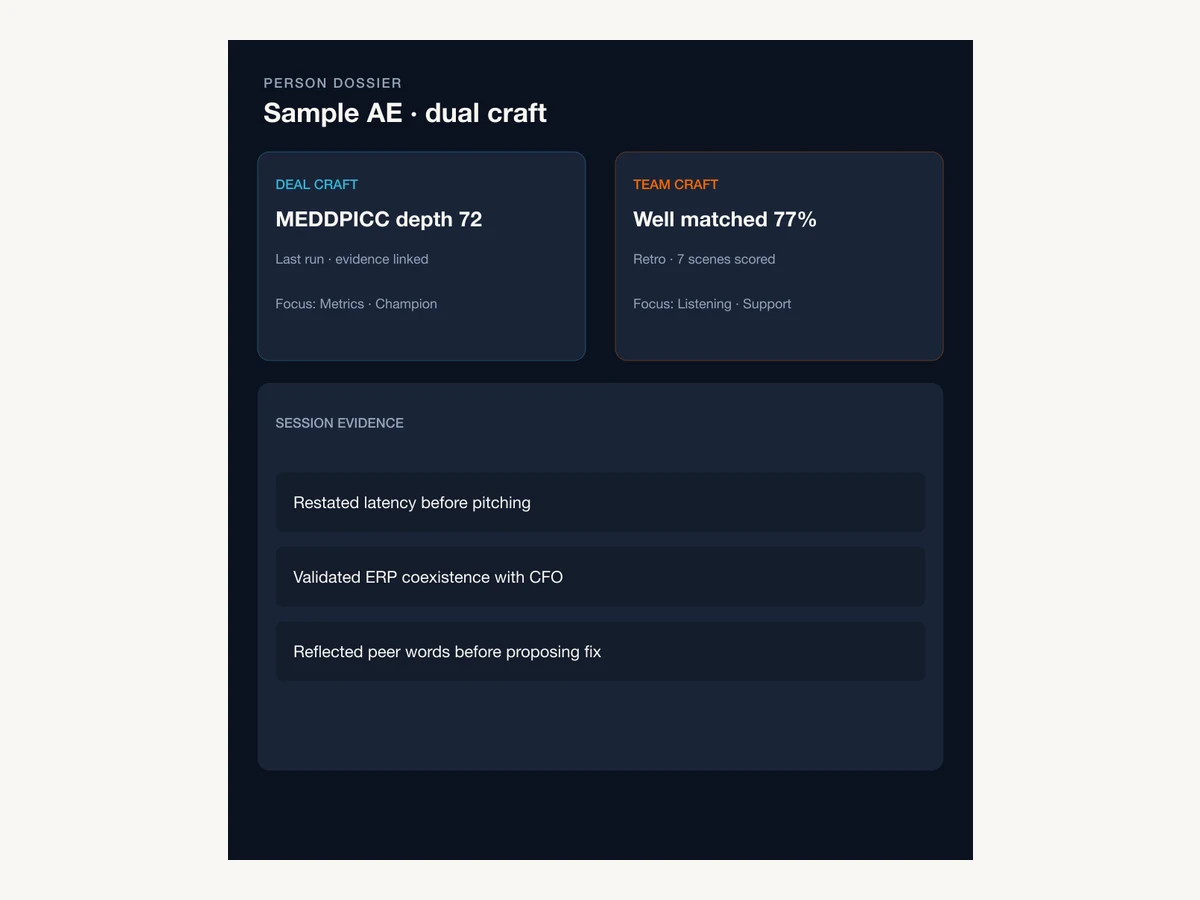
Inspect path seals, focus skills, and engine-versus-manager source tags on one record.
OpenBook discovery
When you want a facilitated walkthrough of cohort cadence in your stack, book a discovery call.
Cohort progression
78% mastery
Share of cohort past checkpoint with evidence, not seat-time.
Decay mitigation
-15% risk
Overdue remeasurement cleared while bands are still fresh.
Queue throughput
12 players / wk
Follow-up kinds managers clear across the cohort spine.
Focus: openable dossier proof and path approvals for CRO review. Not coaching rematch or hiring bands.
Focus: who needs coaching and why from live sims. Not quarter-review dossiers or frozen hire contracts.
Focus: frozen work-sample bands for structured hiring. Not active-team coaching queues or pipeline review packs.
Yes. Queue kinds and path metrics are per person. Small cohorts still show overdue remeasurement, decay, and awaiting approval without inventing cohort-wide averages that hide individuals.
Enablement or the front-line manager. RCC lets you assign three to five focus skills per rep. Rematch on the same beat type is manager work: clear the queue while evidence is fresh.
RCC is the practice evidence and next-mission decision layer. Pair it with your LMS for content libraries; do not treat LMS completion as mastery evidence.
Annual renewal cards fire when status is due or expired. Starting the next verified cycle requires evidence and no low-confidence entries. Drift stays visible as queue work, not silent auto-renewal.
Review scorecards, dossiers, and path seals managers can defend. Exports are not automatic decay-protection claims or invented uplift percentages.
Evidence
Read the verified sales path, then book discovery when you want a facilitated walkthrough of mastery queues in Revenue Command Center.
Open the manager evidence gallery, then book a discovery call when you want a facilitated walkthrough of Revenue Command Center.