
Building is cheap now. Go-to-market is not.
By Sohrab Mostaghim, Game Is Serious, Berlin
Short answer: AI has made it much cheaper and faster to produce software and content. So for most startups, the product is no longer the hard part. Selling it is. In B2B enterprise deals the average buying group is 13 people (Forrester), only 48% of reps reach quota (Bridge Group), and new reps need 6.2 months to ramp, the longest in that study's history. What's left as the constraint is how well the person in the room sells.
I'm a game designer, not a sales leader. I co-founded Farbood, where we designed board games and game-based workshops for companies, and now I'm building DealIQ. So read this as the view of someone who came to selling from the outside. I made the video above first. Then I wanted to check the numbers behind it before I said anything more, so every figure below links to where it came from.
What do the numbers say, at a glance?
| What | Figure | Source |
|---|---|---|
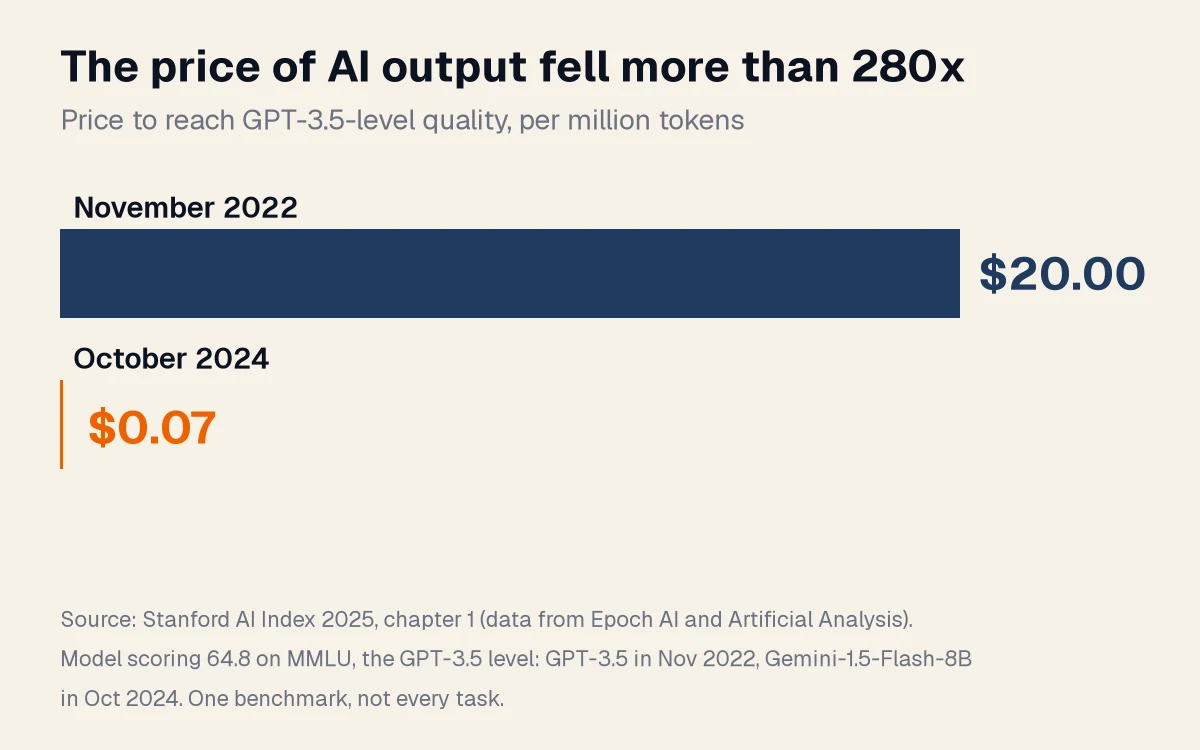
| Cost of GPT-3.5-level AI output, Nov 2022 to Oct 2024 | $20.00 to $0.07 per million tokens (over 280x cheaper) | Stanford AI Index 2025 |
| People in a B2B buying decision | 13 on average; 89% of purchases involve 2+ departments | Forrester, Dec 2024 |
| Buyers who prefer a rep-free experience | 67% (but 69% still validate AI answers with a rep) | Gartner, 2026 |
| Reps who reached quota | 48%, down from 51% in 2024 | Bridge Group, 2026 |
| AE ramp time to full productivity | 6.2 months, highest in study history | Bridge Group, 2026 |
| Sales pros who say customers take longer to decide | 57% | Salesforce State of Sales, 2026 |
Why is building so cheap now?
Two things changed. AI output got cheaper, and people finish tasks faster with it.
Price first. Stanford's AI Index 2025 found that querying a model at GPT-3.5 level went from $20.00 to $0.07 per million tokens between November 2022 and October 2024 (Stanford HAI). That is one benchmark, not every task. But the direction is hard to argue with.
On speed, two controlled studies say roughly the same thing:
- Developers with GitHub Copilot finished a coding task 55.8% faster than developers without it (Peng et al., 2023).
- Professionals using ChatGPT on writing tasks cut their time by 40%, and independent graders rated the quality 18% higher (Noy and Zhang, Science, 2023).
It's not a clean story, and I'd be wary of anyone who tells it that way. In a 2025 trial, experienced open-source developers working on their own mature codebases took 19% longer with AI tools (METR). In February 2026 METR said its newer data was too unreliable to read, and that developers are likely more sped up now (METR update). So it's faster in many tasks and not in all of them.
What does that look like in money? A rough estimate
I wanted a feel for the money, so I did a back-of-the-envelope calculation. It's my own illustration, not a study. Every input is sourced, and the assumptions are listed so you can change them. I could easily be off.
Task A: write one blog post of about 1,300 words.
- Time, human alone: 4h 10min. This is the 2022 peak in Orbit Media's blogger survey, before AI use took off (Orbit Media).
- Pay: $36.98 per hour, median for writers and authors (BLS).
- Human alone: 4.17 h x $36.98 = $154.
- Human plus AI, lab effect: 40% less time (Noy and Zhang) gives 2.5 h x $36.98 = $92.45.
- Tokens, my assumption: 5 drafting rounds, each with 20,000 tokens in and 2,300 tokens out. The 2,300 comes from 1,312 words at about 0.75 words per token (OpenAI), plus about 30% because newer Claude tokenizers produce more tokens (Anthropic). At $2 in and $10 out per million tokens (Claude Sonnet 5.5, same Anthropic page): 100,000 x $2/1M + 11,500 x $10/1M = $0.32.
- Human plus AI total: $92.45 + $0.32 = about $93.
- Reality check: Orbit's 2026 survey, where 92% of bloggers use AI, reports an average of 3h 20min. That is 20% less time than 2022, not 40%.
Task B: build a small HTTP server in JavaScript.
- Time: 160.89 min without Copilot, 71.17 min with it (Peng et al.).
- Pay: $64.44 per hour, median for software developers (BLS).
- Human alone: 2.68 h x $64.44 = $173. With AI: 1.19 h x $64.44 = $76.44.
- Tokens, my assumption: 500,000 in and 50,000 out for an agent-style session, at the same Sonnet 5.5 prices: $1.00 + $0.50 = $1.50. The study itself used Copilot, so this is a stand-in for what the AI part might cost through an API.
- With AI total: about $78.
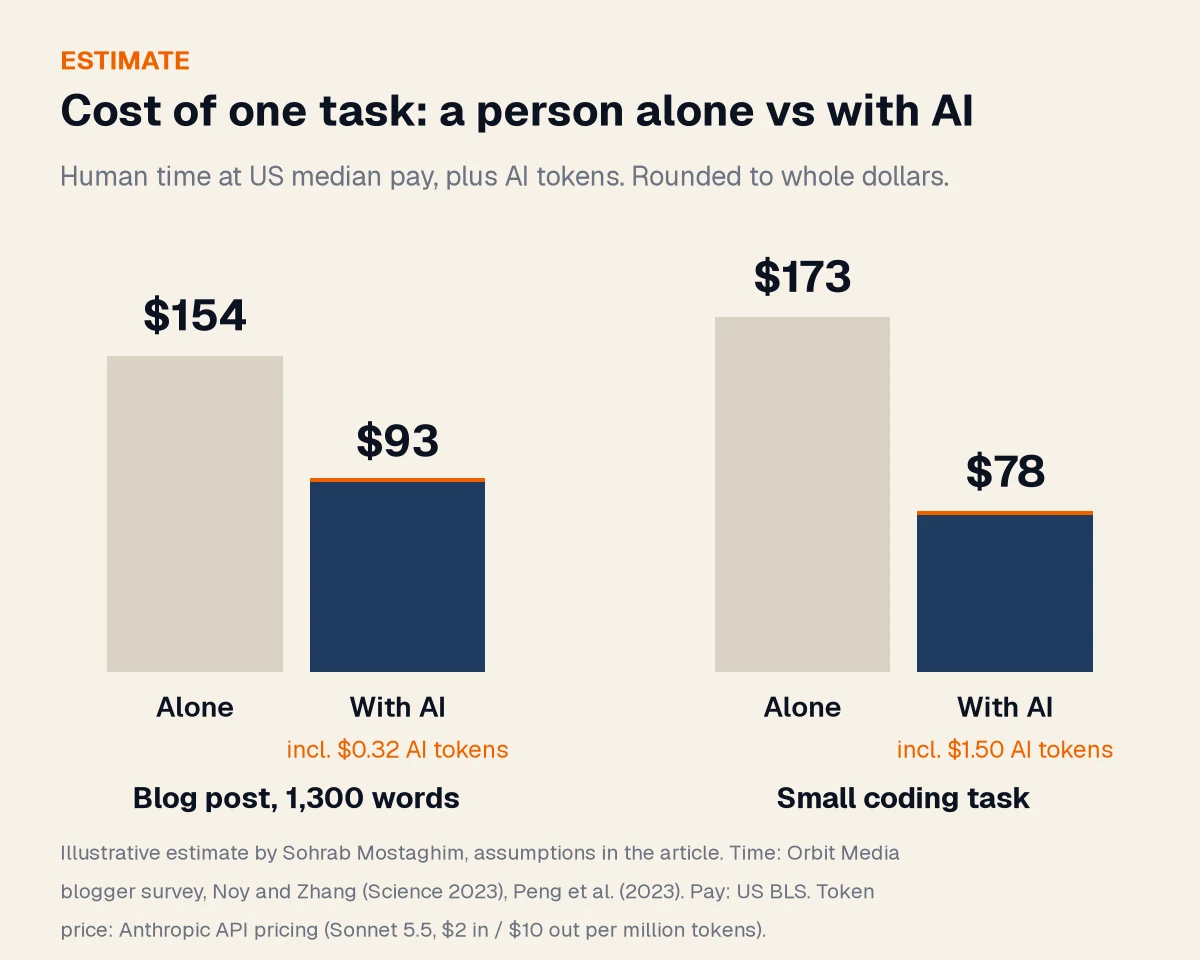
Here's what I take from it. The token bill is cents to a couple of dollars. The human hours still dominate, and AI cut them by roughly 20% to 56% depending on the study. A first draft of a product, a page or a post is now cheap, for you and for every competitor. So the product alone doesn't set you apart anymore.
Why is B2B enterprise selling getting harder?
At the same time, the other side of the table got more crowded and slower.
- Forrester surveyed more than 16,000 business buyers. On average 13 people are involved in a buying decision, and 89% of purchases involve two or more departments (Forrester).
- Gartner found buying groups of 5 to 16 people across up to four functions, and 74% of those teams show "unhealthy conflict" during the decision (Gartner, 2025).
- In Salesforce's survey of 4,050 sales professionals, 57% say customers take longer to decide than they used to, and reps spend 40% of their week actually selling (Salesforce).
You can see it in the rep numbers too. The Bridge Group's 2026 study of 158 B2B companies found 48% of reps at quota, down from 51% in 2024, and a ramp time of 6.2 months, the highest it has recorded. Companies now ask for 3.7 years of experience at hire, up from 2.7 in 2022 (Bridge Group). Bridge notes its sample skews toward companies with engaged revenue leaders, so I'd read it as a direction, not a law.
Do buyers still need salespeople if they prefer to buy without them?
Yes, but at fewer moments. Gartner's 2025 survey of 645 buyers found 67% prefer a rep-free experience and 70% prefer fully digital self-service. In the same survey, 45% used GenAI, and 69% prefer to validate AI-generated insights with a sales rep. Reps stay the most important source when buyers define the problem, pick a supplier, win internal support and close (Gartner, May 2026).
So there are fewer conversations, and each one carries more weight. With a buying group that big and conflict that common, what the rep can do in the room matters a lot. In another Gartner survey of 1,026 sellers, those strong at tactical flexibility were 3.4 times more likely to meet quota, and those good at reading unspoken buyer concerns 2.9 times (Gartner, 2024). These are survey associations, not proof of cause.
How do other high-stakes jobs train, and what can sales learn?
This is the part that pulled me in, probably because I come from games.
Pilots don't learn to handle an emergency by watching videos of landings. In the US, instrument-rating training has to include emergency operations, and a student can log up to 20 hours of that instrument time in an approved simulator or training device, 30 if it is done at a Part 142 training center (14 CFR 61.65). The simulator doesn't replace flying. It lets you rehearse the hard moments before they count.
Researchers who study expert performance call this deliberate practice: effortful activities designed to improve performance, repeated over years (Ericsson, Krampe and Tesch-Romer, 1993).
Most sales training is content, plus the occasional role play with a colleague. A rep's first full enterprise deal is often a real one, with a real account on the line. I think that's the gap. I'm not claiming a simulator makes a great seller. I'm saying that rehearsing the hard moments looks like a sensible place to start.
What am I doing about it?
My bet, coming from games, is that people get good at hard things by playing them, not by reading about them. That's why I'm building DealIQ. A rep works a full enterprise deal: account research first, then a live AI buyer who pushes back, scored on MEDDPICC. The aim is to get the first hard conversation wrong in practice, not in front of a real customer.
I'm not a sales expert and I know it. I lean on my angel and field advisor, Saeid Torkaman, a strategic AE at Wiz/Google Cloud, for what real enterprise deals look like.
We're early. 50+ players so far, and I'm not claiming proven results. If you want to see how it feels, you can try it without a login: DealIQ demo.
FAQ
Is AI making B2B sales easier or harder?
Both, in different places. AI helps with research and admin, and Bridge Group data shows organizations with high AI engagement report more reps at quota (57% vs 39%), though that is observational. But buying groups are bigger and decisions are slower, and 69% of buyers still turn to reps to validate what AI tells them.
How many people are involved in a B2B buying decision?
Forrester's 2024 survey found 13 on average, with 89% of purchases involving two or more departments. Gartner reports groups of 5 to 16 people across up to four functions.
Do B2B buyers want to talk to sales reps?
Mostly not early on. 67% of buyers prefer a rep-free experience (Gartner). But reps remain the most important source when buyers need to validate information, get internal support and finalize the purchase.
How long does a new enterprise sales rep take to ramp up?
The Bridge Group's 2026 study of 158 B2B companies reports 6.2 months on average, the longest in its history.
Every figure above links to its original source. The cost estimate is my own illustration, not a published study.